
Saturday, 1 June 2019

Saturday, 6 April 2019
Difficult kids/kids with difficulties
I managed to catch an actual disorder that was preventing a student from reading properly. I got some help from Robyn Anderson, who has much greater knowledge than I, and she managed to find an initial problem and quick fix. From here I go to our SENCO (Special Education Needs Co ordinator) to try and get some more appropriate support for him.
This year we had a new boy (pseudonym, Bruce Wayne) join our school and class. Bruce came with low capabilities in literacy and numeracy. As the term progressed, Mr Wayne presented with common behaviours that cause problems in the class. There were no records of extra learning needs from his previous school.
During running records, I decided to ask whether the letters on the page seem to jump and move around as I'd noticed Bruce blinking and changing his eye position a lot during reading. He said there were issues, so I got help from Robyn. Robyn figured out that Mr Wayne has a much easier time reading with a green overlay. Bruce's reaction to being able to read letters and words that stayed still was great, and I hope can take advantage of this new development.
Read about Irlen Syndrome here. I'm not sure if it is Irlen Syndrome, but the initial behaviours and checks point towards it.
This year we had a new boy (pseudonym, Bruce Wayne) join our school and class. Bruce came with low capabilities in literacy and numeracy. As the term progressed, Mr Wayne presented with common behaviours that cause problems in the class. There were no records of extra learning needs from his previous school.
During running records, I decided to ask whether the letters on the page seem to jump and move around as I'd noticed Bruce blinking and changing his eye position a lot during reading. He said there were issues, so I got help from Robyn. Robyn figured out that Mr Wayne has a much easier time reading with a green overlay. Bruce's reaction to being able to read letters and words that stayed still was great, and I hope can take advantage of this new development.
Read about Irlen Syndrome here. I'm not sure if it is Irlen Syndrome, but the initial behaviours and checks point towards it.
Teacher Inquiry 2019: Maths ability and Reading comprehension; what's the link?
Nearing the end of Term 1 for 2019, I finally have some time to blog about my teacher inquiry for 2019. This year, Grant and I have decided to do a joint inquiry into poor maths performance and reading comprehension; more on this below. Since we are doing a joint inquiry, most of the posts for this inquiry will be posted on a separate blog with a feed to those posts underneath the header of The Wong Teacher.
The inquiry Grant and I are looking into comes from noticing that some of our students with poor performance in maths have skills and knowledge that are not presented in the standardised tests to evaluate mathematical understanding. There are other factors that contributed to deciding to look into the effects of reading comprehension on maths ability as well. Read about these and further posts to do with the inquiry on the LS1 Teacher Inquiry blog.
The inquiry Grant and I are looking into comes from noticing that some of our students with poor performance in maths have skills and knowledge that are not presented in the standardised tests to evaluate mathematical understanding. There are other factors that contributed to deciding to look into the effects of reading comprehension on maths ability as well. Read about these and further posts to do with the inquiry on the LS1 Teacher Inquiry blog.
Tuesday, 5 February 2019
Class learning sites
Happy New Year.
Winding up into 2019, I have put together a new website for this year's class. It is a new look and different way of thinking for a class site from what I have done in the past. Removing or ignoring the header section of a website in favour of a large icon or linked image has allowed me to reduce clutter on the landing page while keeping it functional. What follows is how I came to that realisation.
One of the aspects learning websites need to consider is how quickly children can access their learning tasks and/or the information they need. Back in 2014, when I was part of the first Manaiakalani Digital Teacher Academy (MDTA), a "3 click site" was suggested as a rule of thumb. This means a site that takes three clicks from the landing page to any piece of information that is needed. The reason for this being that the longer it takes for people to get the information they need, the less likely they are to engage with it... to make a long story short. An example might be if a child needed to do reading, they might start at the landing page, click on a reading button, click on their group button, then click on the link for the week's work.
I have always tried to reduce the number of steps for anyone to get to the information they need while keeping with trends in website design...or at least the trends that work with children's thought processes. In 2018 I developed a "1 click site", thanks to advances in Google Sites. I was able to quickly make a clone for my 2019 site. It wasn't till Robyn Anderson asked for help developing her comic theme idea for a class site (splash below) that I realised I wasn't happy with my own site.


Winding up into 2019, I have put together a new website for this year's class. It is a new look and different way of thinking for a class site from what I have done in the past. Removing or ignoring the header section of a website in favour of a large icon or linked image has allowed me to reduce clutter on the landing page while keeping it functional. What follows is how I came to that realisation.
One of the aspects learning websites need to consider is how quickly children can access their learning tasks and/or the information they need. Back in 2014, when I was part of the first Manaiakalani Digital Teacher Academy (MDTA), a "3 click site" was suggested as a rule of thumb. This means a site that takes three clicks from the landing page to any piece of information that is needed. The reason for this being that the longer it takes for people to get the information they need, the less likely they are to engage with it... to make a long story short. An example might be if a child needed to do reading, they might start at the landing page, click on a reading button, click on their group button, then click on the link for the week's work.
I have always tried to reduce the number of steps for anyone to get to the information they need while keeping with trends in website design...or at least the trends that work with children's thought processes. In 2018 I developed a "1 click site", thanks to advances in Google Sites. I was able to quickly make a clone for my 2019 site. It wasn't till Robyn Anderson asked for help developing her comic theme idea for a class site (splash below) that I realised I wasn't happy with my own site.
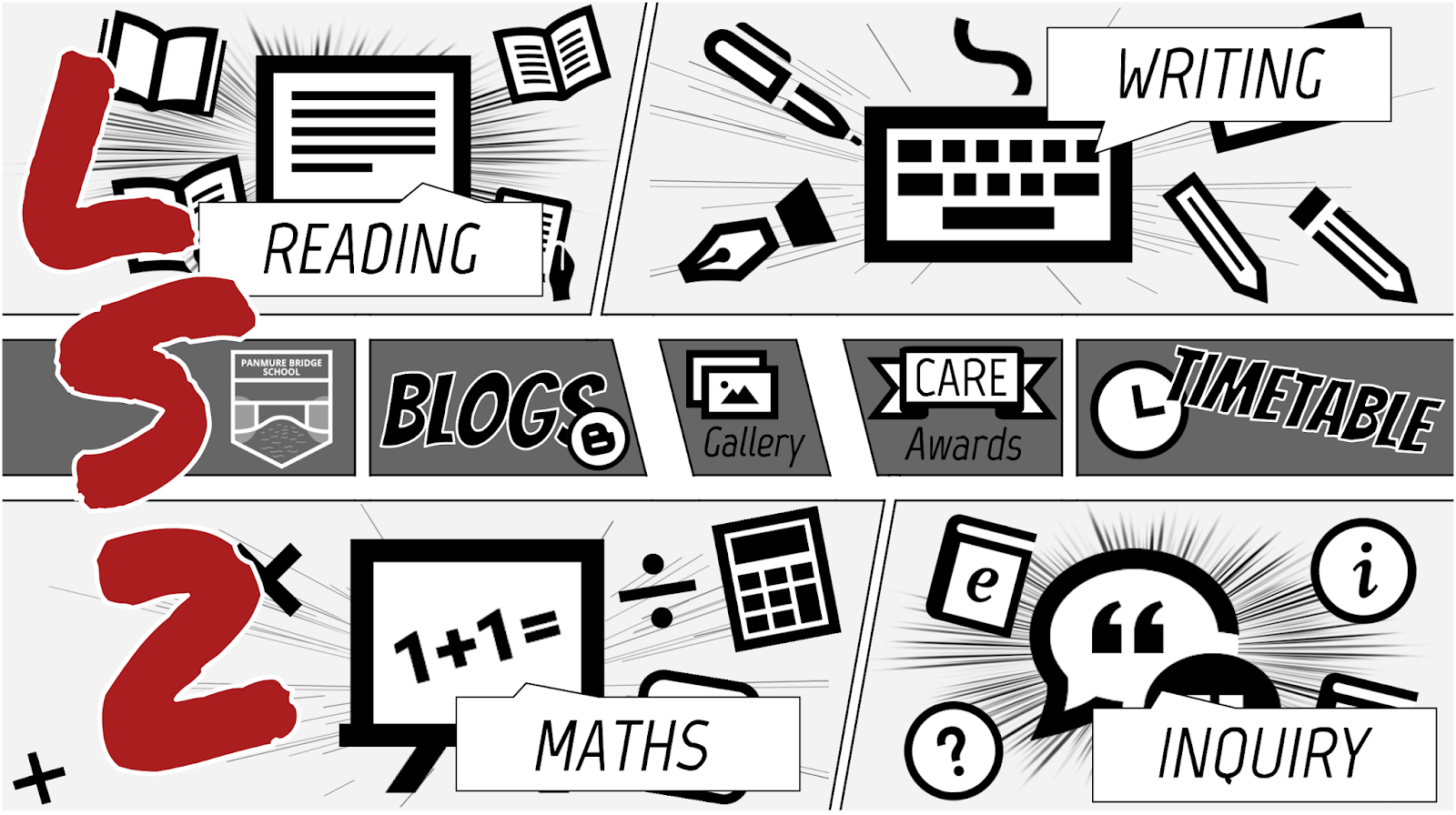
Robyn's site combines the landing page splash with the menu system to cut down the scrolling caused by a site header. Another colleague asked to hep create her website for which I developed an icon to represent her class. The icon's shape allowed me to remove the header from her site as well, which lead me to how to make a landing page I was happy with.

Tuesday, 2 October 2018
Place Value...a teaser
EDCURRIC 714 Exploring Mathematical Thinking taught by Gail Ledger at the University of Auckland is a great paper for learning about how humanity has thought about how number systems work and how the place value system came about. The practical values come in understanding where to start developing the concept of "one" or a single unit and building that into the concept of place value among other mathematical concepts.
 |
| Follow this link to the University of Auckland calendar website. |
 |
| Ancient Egyptian numbers. Source: Grauberg, Eva (see below). |
Now, time for the obligatory declaring of evidence that I have done some reading on the topic and not just pulled these ideas out of thin air. There are many texts on place value and ancient number systems, but here are a few (no, I'm not using any particular format e.g. APA).
Place Value:
- Elementary mathematics and language difficulties; a book for teachers, therapists and parents (1998). Grauberg, Eva.
- Children's Developing Understanding of Place Value: Semiotic Aspects. Maria Varelas and Joe Becker. Cognition and Instruction, Vol. 15, No. 2 (1997), pp. 265-286
- Numbers through the ages (1989), Written Numbers pp. 76--130. Flegg, Graham.
- The Beginnings of Arithmetic, The Mathematical Gazette, Vol. 12, No. 177 (Jul., 1925), pp. 401-414. L. N. G. Filon
- Ancient Egyptian - see above sources
- Chinese -
- Joseph, G. (2011). The crest of the peacock: non-European roots of mathematics (3rd ed.). Princeton: Princeton University Press
- Pellatt, V. (2007). Numbers and numeracy in Chinese culture, language, and education : the social substratum of the development of mathematical thinking.
Friday, 21 September 2018
IKAN results... a small ray of hope
My pupils were tested on their knowledge earlier this term. Generally in New Zealand, this involves the IKAN test. My pupils however often need to be retested on the JAM (junior assessment for maths) to get a clearer idea of what they know as opposed to what they can hear, read, parse, recall, then write down within 3 seconds.
After seeing the results, I had a sense of a general increase in certain domains of maths, especially fractions. I have put it to the test and made a comparison.
With green being the code for an increase in level, this screenshot of my spreadsheet shows that there has indeed been a general improvement in the Overall Level out of the pupils present for both tests (there is one coding error for pupil #28, which made no overall change). IKAN's Overall Level though, is taken from the lowest score within the domain scores, so it doesn't necessarily show improvement. The large number of increases in fractions demonstrates this phenomenon.
I have taken the small win in fractions and have moved on to improving basic facts for the remainder of this term (since about Week 7), and next term I will focus on place value.
After seeing the results, I had a sense of a general increase in certain domains of maths, especially fractions. I have put it to the test and made a comparison.
 |
| Colour coded IKAN shift for 2018 |
I have taken the small win in fractions and have moved on to improving basic facts for the remainder of this term (since about Week 7), and next term I will focus on place value.
Thursday, 13 September 2018
Basic Facts Boxes
Basic Facts... a gap in knowledge that I never had when I was growing up. A gap in knowledge that prevents or hinders improvement in most areas of mathematics. How can Basic Facts knowledge in children, who are in some cases quite far behind expected ability, be brought back to average and boosted further?
Here's something I developed to give it a go.
This Google Sheet populates boxes with random addition and subtraction problems to solve. On entering an answer, the sheet checks the answer and gives immediate feedback. Another sheet in this Spreadsheet does the same for times tables and the corresponding division facts.
I tested the first version of this on my own pupils to limited success. The positive is that many of the kids wanted to keep going until they got everything correct. The negative was that they didn't take screenshots of the boards that had errors, so there was no record of their improvement.
A colleague, Robyn Anderson tested version 2 (without the times tables) with her class. You can read about her success and outcomes I never expected from this tool on her blog post.
The inspiration for this tool came from two places. The first being a Japanese tool for memorising basic facts and the second being Monty Jones's (Tāmaki College) spreadsheets for practising maths problems at secondary school level.
Feel free to copy it, use it, attribute it, and tell me about the successes and challenges you have had.
Here's something I developed to give it a go.
This Google Sheet populates boxes with random addition and subtraction problems to solve. On entering an answer, the sheet checks the answer and gives immediate feedback. Another sheet in this Spreadsheet does the same for times tables and the corresponding division facts.
I tested the first version of this on my own pupils to limited success. The positive is that many of the kids wanted to keep going until they got everything correct. The negative was that they didn't take screenshots of the boards that had errors, so there was no record of their improvement.
A colleague, Robyn Anderson tested version 2 (without the times tables) with her class. You can read about her success and outcomes I never expected from this tool on her blog post.
The inspiration for this tool came from two places. The first being a Japanese tool for memorising basic facts and the second being Monty Jones's (Tāmaki College) spreadsheets for practising maths problems at secondary school level.
Feel free to copy it, use it, attribute it, and tell me about the successes and challenges you have had.
Subscribe to:
Posts (Atom)